Thursday, June 28, 2012

Reach Out

The Problem: One-Third of Children Enter School Unprepared to Learn.  Helping with a solution is an organization called Reach Out and Read, http://www.reachoutandread.org.  On their website they state that the clear solution is for all adults to speak and read to young children as an everyday nurturing activity. Research shows that words heard on television and radio programs do not
have the same impact as live, spoken conversation. The reason is simple: children want to learn language in order to communicate with the people who mean the most to them: their parents. Of all parent-child activities, reading aloud provides the richest exposure to language. Unfortunately, fewer than half of young American children are read to daily.  Reading aloud is not only one of the best activities to stimulate language and cognitive skills; it also builds motivation, curiosity, and
memory.
The Literacy Alliance is helping with the solution by providing storytime programs for preschoolers through the Boys Town Storytelling Troupe and our awesome storytelling volunteers in Head Start facilities, VPKs and the Orlando Homeless Shelter.  By modeling good reading aloud practices and providing quality books to teachers and parents, we excite their interest in reading as a daily classroom or family activity.  It certainly makes sense to reach out and read.

Saturday, June 23, 2012

Be Free!

“Once you learn to read, you will be forever free.” 
― Frederick Douglass
Frederick Douglass, born a slave in 1818, grew to be internationally recognized as an uncompromising abolitionist, a tireless worker for justice and equal opportunity, and an unyielding defender of women's rights. Frederick was taken from his mother when only a few weeks old and abandoned by his grandmother at the age of six. However, at the age of eight, Frederick exchanged food for lessons in reading and writing. When he was a young teenager he purchased a copy of The Columbian Orator which helped him gain an understanding and appreciation of the power of the spoken and written word. He learned that the most effective means to bring about permanent and positive change was through the spoken and written word. Douglas said, "What is possible for me is possible for you."     
Claim your freedom - read!

Tuesday, June 5, 2012

Slip into another's skin!

“Reading is the sole means by which we slip, involuntarily, often helplessly, into another's skin, another's voice, another's soul.”

Joyce Carol Oates, award winning author

At The Literacy Alliance we hope to inspire students to read and slip into a different world; to experience something different or something comforting or something thoughtful or something familiar or something uncomfortable. What better way to learn how a person of a different gender or race or economic status or age lives than to step into his or her life by reading a book. We must learn about others in order to understand others. If we can learn and understand, we can relate and we can communicate. If we can communicate, we can overcome anything - it all begins with reading.

In our booktalk program, we go into middle school classrooms and inspire students to read. Here is a 6th grader's comment about one of our booktalks:  "Thank you so much for coming to our school and sharing books with us. I never really like reading, but the way you explained about the books makes me want to read more. The one book that really stood out to me was The Wreckers! I love the way you put the story. The sound effects were amazing and made your voice stand out. I hope that you will be able to come when I am in eighth grade. Thank you so much again!" 

What book allowed you to slip into another's skin or voice or soul?

Sunday, June 3, 2012

Children’s fiction - perfect for the bathroom!


“Reading is important. Books are important. . . . Children’s fiction is the most important fiction of all. We who make stories know that we tell lies for a living. But they are good lies that say true things, and we owe it to our readers to build them as best we can. Because somewhere out there is someone who needs that story. Someone who will grow up with a different landscape, who without that story will be a different person. And who with that story may have hope, or wisdom, or kindness, or comfort. And that is why we write.” The Horn Book Magazine, July/August 2009. Quote from author Neil Gaiman's (http://www.neilgaiman.com/) acceptance speech for the 2009 Newbery Medal Award winner, The Graveyard Book.

Children's literature is the beginning of a love of reading. Expose your child to literature early and often. Convey to your child that books are a treat and a fun way to spend time. Surround him with books; in the bathtub (I'm not kidding, look for plastic books in book stores), while potty training (a great way to spend time while sitting and waiting for something  to happen), in the car (have books in car pockets for easy access), in strollers (along with a favorite stuffed animal, be sure to store favorite books), at grandma's house (be sure relatives and babysitters have books available). 

And choose with care the books to surround your child. Spend time in the library browsing through the books. Choose authors your friends, librarians, or educators have recommended. Authors such as Eric Carle, Jan Thomas, Mo Willems, Leah Wilcox, Quentin Blake, and Mary Ann Hoberman. But also pick books at random and let your child choose the books. You never know when you will stumble upon a real treasure.  

But suppose a random book turns out to be a dud? Not to worry. Not every book speaks to every person. Show your child that she does not have to read everything and anything.  If she begins a book and it isn't of interest, let her put it down. Perhaps she'll come back to it later or perhaps just return it unfinished. Let her know that starting a book does not mean it must be finished. Do not worry, a book of worth will always hold her attention. Soon she will learn that books are stories that bring hope, or wisdom, or kindness, or comfort and let her view other lives and other places. If a book is taking her somewhere she wants to go, she will finish that book.

The photo at the beginning of this article shows a young girl reading in a most amusing location. I once found my son reading under the dining room table. I loved it, it was adorable. Where is the oddest place you have found your child reading?

Wednesday, May 30, 2012

The Key to Reading is Desire


"In concentrating almost exclusively on teaching the child HOW to read, we have forgotten to teach him to want to read. And there is the key: desire."  This quote from Jim Trelease (http://www.trelease-on-reading.com/), highlights the need for children to love reading. As parents we get to help develop that love of reading by simply reading with our children. Sitting down with our children and spending time quietly reading a book will bring laughter, smiles, and an enjoyable moment. Each reading moment will help our children enjoy reading more and more. They will want to hide in their covers and read on their own! And the more they read, the better readers they become and the more their lives are enriched.

My children are in their twenties now, but when they were younger, I enjoyed reading many books with them. When they were in elementary school, one of the books we enjoyed reading together was A Long Way from Chicago by Richard Peck. What books have you read with your child/children?

Wednesday, May 23, 2012

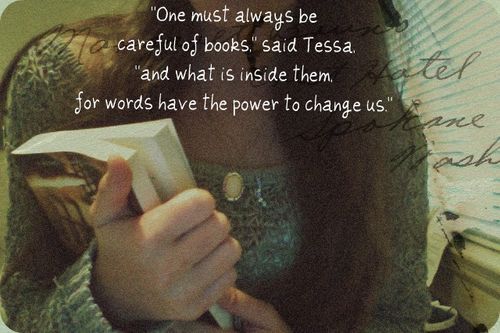
Books have the power to change us!


This quote from Clockwork Angel by best selling young adult author, Cassandra Clare, 
is our quote of the week!

Friday, May 11, 2012

Maurice Sendak and art in children's literature

"You can forget the story," says Amanda Craig, "but the image is there forever." She continues, "An embattled headmaster recently told me that all his life he'd carried with him a vision of mountains soaring up to the sky, which consoled him in moments of crisis. He believed he'd invented it, or seen it in a dream. It was only when he read Beatrix Potter to his grandchildren that he realized it was a picture from The Tale of Mrs Tiggywinkle."  
Kate DiCamillo, a Newbery Medal winner and the author of Because of Winn-Dixie wrote, "The first book I read by myself was Else Holmelund Minarik's Little Bear. The illustrations were by Maurice Sendak. Those first words that I read by myself are intimately and forever bound to the art that appeared above them. It was as if the art were the doorway and it ushered me toward the words waiting on the other side. I entered the text through the art. It was one of the most powerful moments of my life."  

Maurice Sendak, author of over a dozen books and illustrator of more than 100 books has sold millions of books and won every top honor in his profession, including the Caldecott Medal and the Hans Christian Andersen Award. When I heard the news of his passing I went to my bookshelf and pulled down my copy of Where the Wild Things Are, his most notable work. The book had been given to me when I first became a children's librarian. In the front my friend wrote, "For all the new little wild things. Congratulations!" A wonderful beginning. 

Mauice Sendak will be missed. "And now,"cried Max, "let the wild rumpus start!"